By: Jannicke Moe (NIVA), Anders L Madsen (HUGIN), Sophie Mentzel (NIVA) and Rik Oldenkamp (Vrije Universiteit Amsterdam)
WWW: Anders L Madsen (HUGIN), Jannicke Moe (NIVA
Created: 2022-10-28
Latest update: 2023-06-29
Pesticides In Streams
This Bayesian network model shows an example of integrating global climate change (GCC) modelling with environmental risk of chemicals. The model represent as case study on exposure and risk of pesticides from agricultural fields to aquatic communities in streams in Southeast Norway (Mentzel et al. 2022a, 2022b). The case study was developed in the European ITN ECORISK2050 and was further developed in a SETAC Pellston workshop on of integration GCC modeling into ecological risk assessment. The model currently represents the effect of increased precipitation on pesticide runoff and exposure. This website is still under development, more information will be provided later.
Below is a set of HUGIN widgets for interacting with the model:
Risk of pesticides in streams
Scenario
To appear.
Climate
Application
Hydro/Chemistry
Exposure
Effect
Structure of the Bayesian Network Model
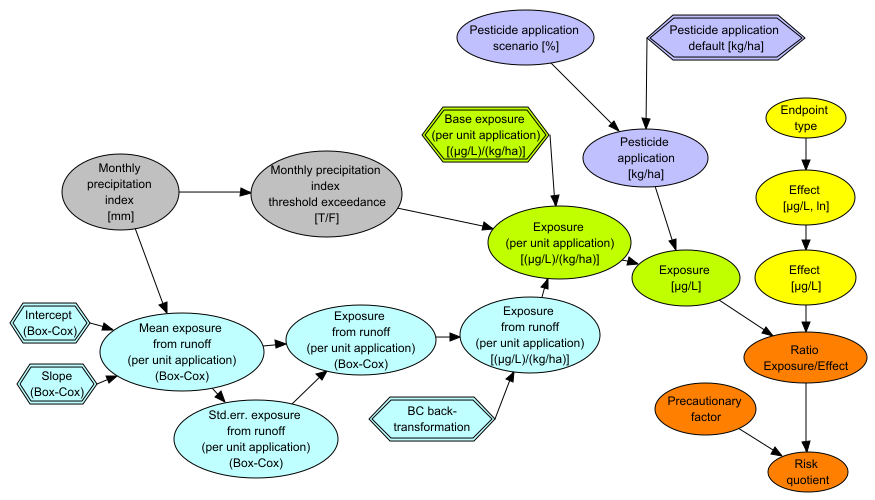
The current climate scenarios and models are taken from Mentzel et al. 2022b for the purpose of model development. They will later be replaced with more updated IPCC scenarios and a higher number of climate models.
References and Further Reading
[1] U. B. Kjærulff and A. L. Madsen, Bayesian Networks and Influence Diagrams, Second Edi. Springer, 2013.
[2] R.E. Neapolitan, Learning Bayesian Networks, Pearson Education, Inc., 2004
[3] F.V. Jensen, Bayesian Networks and Decision Graphs, Springer-Verlag, Inc., 2001
[4] K.B. Korb and A.E. Nicholson, Bayesian Artificial Intelligence, Chapman & Hall/CRC, Second Edition, 2011
[5] J. Pearl, Probabilistic Reasoning in Intelligent Systems: Networks of Plausible Inference, Morgan Kaufmann Publishers, 1988
[6] D. Koller and N. Friedman, Probabilistic Graphical Models: Principles and Techniques, MIT Press, 2009
[7] D. N. Barton et al., Bayesian networks in environmental and resource management, Integr. Environ. Assess. Manag., vol. 8, no. 3, 2012.
[8] Mentzel, S. et al. 2022a. Development of Bayesian network for probabilistic risk assessment of pesticides. Integr. Environ. Assess. Manag. 18: 1072-1087. https://setac.onlinelibrary.wiley.com/doi/10.1002/ieam.4533
[9] Mentzel, S. et al. 2022b. Probabilistic risk assessment of pesticides under future agricultural and climate scenarios using a Bayesian network. Front. Environ. Sci. https://doi.org/10.3389/fenvs.2022.957926
[10] Moe, S.J., R.E. Benestad, W.G. Landis. 2022. Robust risk assessments require probabilistic approaches. Integr. Environ. Assess. Manag. https://doi.org/10.1002/ieam.4660
[11] Oldenkamp, R., Benestad, R.E., Hader, J.D., Mentzel, S., Nathan, R., Madsen, A.L., Moe, S.J. 2023. Incorporating climate projections in the environmental risk assessment of pesticides in aquatic ecosystems. Integrated Environmental Assessment and Management Integrated Environmental Assessment and Management. https://setac.onlinelibrary.wiley.com/doi/epdf/10.1002/ieam.4849
Contact information
For further details on the study and Bayesian network model: Jannicke Moe (jmo(at)niva(dot)no)
For further details on the use of Bayesian networks and web deployment of models contact: Anders L Madsen (alm(at)hugin(dot)com)